churches changing communities

Tuesday, March 24, 2015

What I love about our mission in Tanzania is not that we get to do some great stuff to help people there, but that we're helping churches be change agent in their communities.

Partnering with churches makes sense because it's an effective strategy for community development. That, and because I also believe in a God who want to use his church/people to be agents of transformation in our world. I believe in a God of mercy who loves justice and whose heart is broken by the plight of the poor and the suffering in our world. A God who entered into our suffering to redeem his broken creation through his Son Jesus Christ. A God who invites his followers to be his hands and feet and join in redeeming this broken world. That's a powerful reason to believe in the church as an essential element in community development. But I want to focus on why it makes sense to do community development through the local church from a practical perspective. Something we can all relate to regardless of faith or worldview.


Community development is most effective when it comes alongside people who are already trying to help themselves. It's empowering people who already have a vision and maybe even a plan and helping them achieve their goals. Sometimes a community might form a committee to address a particular issue. Like a community based orphan care center to give orphans an early childhood education and provide some respite for their extended family caregivers. Often churches are behind such community based initiatives. The local church is usually in a position of respect and influence. The church is aware of the needs in its community and it has a mandate to care for the poor, the widows, the orphans, and the suffering. As an outsider it takes a lot of work to discover the story of a community -- who's who, the history of certain problems, what's been done, what's available, etc. That's why it makes sense to partner with a local influential organization that wants so see its community flourish.


This model for community development is what's exciting about the work we will be doing with Emmanuel International in Tanzania. Tearfund is an organization that has championed this model of community development and summarizes it as follows:


"Church and community mobilisation involves mobilising a local church to act as a facilitator in mobilising the whole community to address their own needs.

This approach is different from the ‘church mobilisation’ approach because, once the local church is mobilised, it becomes a facilitator rather than the provider. The local church seeks to envision and empower community members to identify and respond to their own needs, rather than meeting those needs for them. The local church therefore works with rather than for the community. The community is in control. The local church can provide ongoing support to the community, and the community may call upon Christian organisations for technical support where necessary."
- tilz.tearfund.org

Umoja, which means ‘togetherness’ in the Swahili language of East Africa, is an exciting and transformational church and community initiative. It helps church leaders and their congregations work together with the local community to bring about positive change for the whole community.

Umoja helps local churches and communities build on the resources and skills they already have. It is a process that inspires and equips local people with a vision for determining their own future with their own resources."
- tearfund.org
 

profitable agriculture

Wednesday, March 18, 2015

Most people in Tanzania are subsistence farmers. They grow just (not quite) enough food to feed their families. Many of them live in poverty. As a result, farming is not viewed as a profitable opportunity. Tanzania's youth don't necessarily aspire to be farmers. It's only a means to survival.

But what if farming could lead to abundance? If a career in agriculture could be profitable?

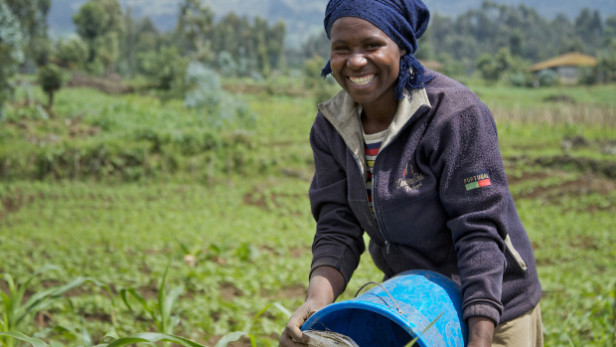
Agriculture can be an essential driver of economic development and an area of great opportunity for Africa's youth. However, most young people in the region do not see agriculture as a profitable opportunity. Photo by: The MasterCard Foundation on Devex

Increasing productivity and improving crop yields is essential for changing perspectives on agriculture and effective community development in Tanzania. By implementing conservation agriculture practices farmers can build the productivity of their soils through composting and mulching. By building up and taking care of the soil on their farms, the soil will become more fertile, maintain soil moisture, and protect the soil from the effects of the hot African sun and the torrential rains. Many farmers can't afford expensive chemical fertilizers but these fertilizers only feed their crops and do nothing for the soil. Improving the farmer's soil provides long-term sustainable productivity with minimal inputs. In addition, farmers can incorporate certain species of beneficial trees into their gardens through agroforestry and Farmer Managed Natural Regeneration (FMNR) to draw soil nutrients to the surface where they're accessible to crops, fixing nitrogen in the soil, and providing mulch, in addition to reducing soil erosion, providing a source of forage and fuel wood, etc.

These are just some of the practices that we might promote to help farmers in Tanzania realize abundance on their farms. You can be part of the transformation. Would you consider supporting our work among Tanzania's farmers?

read more...
devex: envisioning agriculture as a business for youth in Africa

Africa's beauty is rivaled only by her destitution, her richness in natural resources comparable only to the suffering of her people. Farming God's Way empowers farmers to break free from the bondage of poverty and make use of the natural resources that surrounds them. By empowering farmers to trnsform their farms into economiclly viable ventures, it moves farmers from sufficiency to abundance, from subsistence to surplus.

support update

Sunday, March 8, 2015

Last month we posted a diagram that showed the support we still need to raise before we can schedule our departure for Tanzania. Thanks to those who joined our Support Team in February, we are currently at 60% of our monthly support. We have another ambitious goal to get our support up to 75% by the end of March so that we can be on schedule to have all our support pledged by June!!

Would you consider joining our Support Team? Schedule a coffee with us if you want to learn more about our mission or download a support form to be part of what we're doing in Tanzania.


rallying for Tanzania

Sunday, February 22, 2015


Yesterday marked a year since our official acceptance with Emmanuel International to serve in Tanzania, launching us into the "rallying" phase to build a support network that will make this calling a reality for our family. We want to thank everyone for the support and encouragement we have received along the way. We are currently at 58% of our monthly support needed to leave for Tanzania and we have been encouraged by the recent influx of supporters joining our team! Thank you!

Our goal is to have 100% of our support pledged by June. Please let us know if you can join our support team or would like to learn more about what we're doing in Tanzania!


Tanzania over coffee and dessert

Sunday, February 15, 2015

Are you interested in what we're doing in Tanzania but want to learn more?

Join us for an informative dessert evening in Greendale on Friday February 20, 7-9pm.

Learn about Tanzania and what we're doing there while you enjoy a cup of Tanzanian coffee and a dessert with friends. There will also be some items for sale with proceeds going to our mission:
  • fair-trade coffees and teas from Tanzania and other places
  • hand-made jewelry from Malawi and Haiti
  • Epicure spices and goodies
If the date doesn't work out for you, give us a shout and we'll grab a Starbucks or Tim's coffee and share our mission with you (if you're in the Fraser Valley, otherwise maybe just a phone call?).


join our Support Team

Friday, February 6, 2015

Thanks to everyone who has already committed to supporting us, we are nearly halfway to our required support level to make our mission in Tanzania a reality. We are trusting God to provide for our needs as we aim for our departure goal in June. We did some calculating and we figure we need 60 more people who will support us financially (based on the  support scenario below) and at least 25 more people who will commit to praying for us (the more the better).

Would you consider joining our Support Team? >> download a support form here

Tropical Agriculture Development

Thursday, January 29, 2015

Last week, I (Andre) had the opportunity to take a course in Tropical Agriculture Development with ECHO in Florida. It was an excellent course that I wish I had taken a few years ago before our time in Malawi. I spent a week at ECHO's 50-acre Global Farm that is home to tropical trees and plants from around the world and demonstrates agriculture practices in the tropical lowlands, highlands, rainforest, semi-arid tropics, as well as urban gardens. It's an amazing setting for learning about sustainable agriculture and community development from a devoted team of staff and teachers who have a wealth of experience in agriculture missions.


more pictures on our facebook page

I gained a greater appreciation for soil life and why conservation agriculture is so important for subsistence farmers. I learned about Moringa and Katuk and Chaya and many other underutilized plants and multipurpose trees that can make a huge difference for farmers (for lunch one day we handpicked leaves and fruits from over 40 species of plants on the farm -- amazing diversity!). And we got some good exposure to integrated animal production and numerous appropriate technologies. A lot of good ideas and information packed into a week!

As we look forward to Tanzania, I'm excited about trying as many of the agricultural crops, practices, and technologies in our own backyard as we can. We will see what will be most helpful to the farmers we work with in each village as we learn what their real needs and wants are. It might be conservation farming and composting to rebuild the soil and improve crop production. It could be planting some underutilized crops to improve nutrition. Or some form of agroforestry to reduce erosion and improve growing conditions. As we anticipate working in a number of villages to address the complex issues of poverty, I am thankful to be part of the ECHO Community of development workers around the world and to have access to the vast network of knowledge and expertise it represents.

Thanks to our supporters for making it possible for me to take this valuable course.

January newsletter

You can find our latest newsletter in our newsletters archive. 
  • some interesting facts on tropical agriculture
  • Missions Fest Vancouver this weekend
  • support update and prayer and praise items